Years ago, I told a woman in my practice: “You are the flower. He can come to you for the nectar. You don’t need to be the one constantly going after him asking, ‘Do you need this now? Can I give it to you in this way?’”
She looked at me like I’d lost my mind. She was exhausted—pursuing her husband for years, managing his moods, anticipating his needs, chasing his attention, decoding his silences. But she believed this was what love asked of her.
“You need to be a radiant magnetic pole,” I said.
The look on her face.
• • • • •
Recently, in a conversation she raised about indigenous perspectives on the unconscious (yes, we have deep and meaningful conversations in our sessions), something landed that brought this teaching back to me—and deepened both of our understandings of the content from years ago:
Indigenous peoples don’t think they dominate the planet. They live in harmony. Things are speaking to them all the time, and they are listening for it.
Most tribal rituals are about listening to the world around them. They are the flower in the garden, and the world comes to them. Bees pollinate. Birds drink. Weather comes and goes, but their roots remain.
This is the view of our humanity that we have lost. And this is where relationships fall out of balance too.
Think about what it does to the nervous system to always be conquering, grasping, pursuing. And what it would mean to refrain from that. What would you be doing then?
Receiving.
If you think about trees, they are entirely dependent on pollination, which they cannot do for themselves.
This is what the indigenous peoples call interdependency. Not just a nice concept—but rather a survival fact.
We are born into an omnipresent universe. And if we don’t trust it—if we don’t submit to it—we won’t allow our caregivers to give to us and we won’t allow ourselves to receive. We’ll keep trying to pollinate ourselves. We’ll exhaust ourselves reaching for what is designed to come to us.
The tree’s survival strategy is receiving from the world around it and being a tree in response. That’s the interdependency relationships also thrive within. The tree survives by being the tree. By staying in harmony. Its survival is its receptivity.
Yet many of us as couples suffer from thinking—and behaving like—it’s our job to make sure we get pollinated by doing something outside our natural state in order to earn it. We chase our partners. We manage their moods. We exhaust ourselves reaching for what is designed to come to us naturally, if we’d only stand in the unknown long enough to receive it.
• • • • •
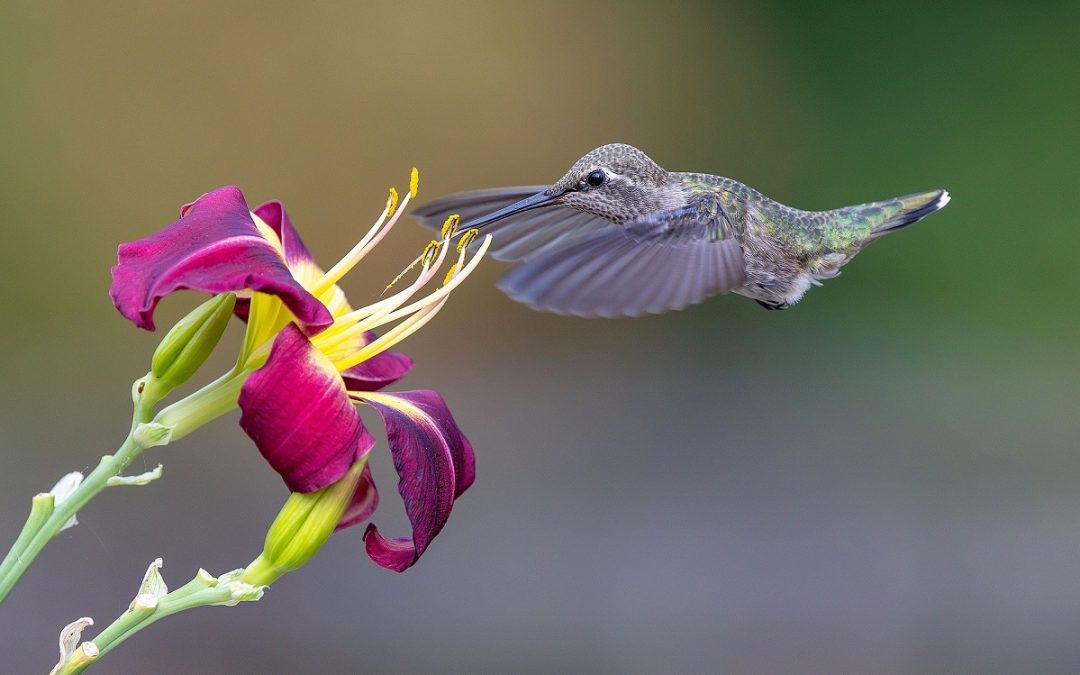
The flower survives by being the flower. Not by worrying about whether the hummingbird is coming. Not by stretching its petals toward things it cannot reach. The flower’s survival is its receptivity.
My client reminds me that there is an ancient Nahuatl story from Mexico called Xochitl. Two lovers are separated, and to stay connected, she becomes a flower and he becomes a hummingbird. He keeps returning to her. Because that’s what hummingbirds do. They seek the nectar, are drawn to its scent, and know when to drink and from which flower.
That story shows up everywhere, she tells me—in Puerto Rico as Alita and Taru, in traditions across Latin America. Different languages, same archetype. Same teaching. Same insight I shared with her years ago.
The flower doesn’t chase the hummingbird. The flower blooms. And the hummingbird comes.
Your own love story most likely started this way—one blooming, one arriving. And did your union nurture that dynamic or flip it on its head?
• • • • •
But what about desire, you may ask? What about reaching toward the person you love during tough unreachable times? What about showing up, fighting for the relationship, doing the work?
Yes, yes. Of course. All of that.
But there’s a difference between showing up and chasing. There’s a difference between being present and performing for love so frantically that neither of you can feel or find it anymore.
• • • • •
In a moment of painful reaching in my own life, one of my teachers pulled me back by saying, “KD, remember, this is happening for you, not to you.”
Kaboom! I was back in the center of my life—receiving the lessons I needed, the insights I sought, feeling the tough stuff that stings when you first hear it. Receiving with grace again, and capacity, humility and surrender, I shifted and returned to expanding instead of contracting.
That’s the flower’s orientation. The flower doesn’t respond to the bee who is on another flower. The flower is there. The bee arrives. And both receive from that moment’s union.
When you flip the orientation—when you stop being the object of love’s events and become the subject through which love moves—something changes in your embodiment. Your nervous system settles. You go from grasping to receiving. From conquest to harmony.
• • • • •
So much of relationship trouble comes down to two people who have forgotten who is the flower and who is the bird/bee in any given moment. One chases and in reaction the other retreats. When the pollinator is retreating, no growth, no sustenance—just fatigue. And the flower wilts from trying.
And that old story that rears its head and controls your mind—the one that says, “You’re not lovable enough, not doing enough, not giving enough”—that’s not information. That’s archaeology. An old memory surfacing, asking to be tended. A younger part of you that needs to hear: You are enough. You don’t have to earn this. Breathe. Let go. Let in what you fear you’ve lost.
• • • • •
I work with a framework I developed called MESHE, HESHE, MISON & ORBIT. It maps the interweaving reality of self, life, and other—how we stay in relationship, how we fall out, how we find our way back.
MESHE (mee-shee) is your relationship with yourself. HESHE (hee-shee) is your relationship with other—a person, a place, a thing, even a thought. And that relationship doesn’t happen inside you or inside the other. It happens in the Space between. That Space is not a void. It is alive. That space is MISON (my-sahn)—Life Itself.
When you trust the interweaving nature of self, life, and other, everything shifts. You are not alone in the gap between yourself and your partner. You are steeped in life itself. Life is what comes to you and loves. Other is the form life is taking. You are connected through the Space, not despite it. When you are flower, life itself is the hummingbird and vice versa.
The love that flows to you, or that draws you in and receives you, is a personification of the fullness of life. It isn’t earned—it’s a birthright. It’s the is of everything.
This is what the flower knows. The hummingbird will come because the Space between them is alive and full of loving potential!
• • • • •
And when you forget? When you fall into old patterns and find yourself chasing again? Forgive the fall. That’s ORBIT (or-bit). It’s part of the dance. We lose ourselves a thousand times over. The question is never if. The question is whether you remember that letting go and letting in is the way back.
Be the flower in love. Flowers don’t chase the sun—they root down and turn toward it. The pollinators know where to find them. And they know where to find you too.
MESHE is the way back. Your “you.”
© Copyright 2026 KD Farris. All Rights Reserved.
Doctor of Depth Psychology, writing, speaking & teaching on the practical application of key concepts and processes. Author of MESHE, HESHE, MISON & ORBIT: What My Grandmother Taught Me About the Universe—a spiritual coming of age story set in 1960’s Hawaii for the 13-year-old in all of us. Now available on Audible.com.