|
The Audible Life Stream, or Primordial Sound
Current, is the all-pervasive universal
consciousness within everyone. Few realise there
is credible evidence indicating that Jesus,
Buddha, Krishna, and so on, all perfected the
meditative technique of turning their attention
inwards, thereby merging with the Audible Life
Stream, to become adepts of dying while living.
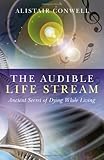
The Audible Life Stream: Ancient Secret of
Dying While Living is the first book to
provide convincing evidence of the Audible Life
Stream and emphasise the importance of it to
every human being, since none of us can escape
the clutches of the Lord of Death. This unique
book provides evidence of the Audible Life
Stream from a variety of sources, including,
independent testimonials of near-death
experiences (NDE) and out-of-body experiences
from people in USA, UK and Australia; excerpts
from major religious texts; simply explained
quantum physics principles; and independent
anecdotes from the increasingly popular field of
sound/music therapy.
In this excerpt from Chapter 1 of the book, the
nature of the largely unconscious fear of death
within many of us is discussed.
Chapter One
Trembling on the Edge of Eternity
Death is psychologically as important as birth.
Shrinking away from it is something unhealthy
and abnormal which robs the second half of life
of its purpose. -
Carl G. Jung (1875–1961)
Some years ago in the west country of England, a
man was found wandering the streets in a highly
disturbed state. Determining that the man
required medical attention, he was sent by a
benevolent organization, called the Bed Bureau,
to the local general hospital. The man was of no
fixed address and doctors were unable to contact
any friends or relatives. He was so afraid that
no information about him, or what had happened
to make him so unsettled, could be obtained.
Totally unwilling to answer any questions, he
instead kept shouting that he was going to die
and was begging for help.
The then admitting physician of the hospital, Dr
J C Barker, explains what transpired:
He defied all our attempts to sedate or
resuscitate him and
continued to cry out that he was going to die.
Then to our
horror and amazement he suddenly stopped crying,
fell back
into the bed and quickly expired. He had been in
hospital for
about half an hour. A post-mortem examination
showed him
to be in perfect health and there was nothing to
account for
his demise, except perhaps fear... I was quite
convinced that it
was possible for a perfectly healthy man to be
frightened to
death.1
Such extreme cases as these (and this was not an
isolated case that Dr Barker was involved with
first-hand) highlight how strongly the fear of
death can manifest in us. Psychologists have
found that the vast majority of us harbor an
intense fear of death. The medical profession
has even coined the word thanatophobia,
which is derived from the Greek word,
thanatos, meaning death, for this fear.
Dr Barker believes emphatically that no one is
exempt from the fear of death. In his book,
Scared to Death, he describes thanatophobia
as a very distinct, unique and sometimes
all-consuming fear. The fear is so great and so
deep that many of us deny the fear itself as a
means to repress it.
A Paradoxical Obsession
But this repression is most insidious because we
all know that literature, music and art have
long had an obsession with death. Like the theme
of romance, audiences in the main thoroughly
enjoy witnessing death enacted on stage or the
screen. Many operas include a death scene
because, as the ultimate of tragedies, death is
the perfect climax to drama. Puccini’s deeply
moving Madama Butterfly is perhaps one of
the best known examples. After finally realizing
that her unfaithful American husband has
betrayed her and their son for another woman, a
distraught and disillusioned Butterfly takes her
own life. In this case, whether it’s a question
of honor or foolishness is debatable, but in the
final analysis it is also immaterial because the
power of Butterfly’s actions overwhelms a cold,
purely rational mind searching for reason.
Our strangely paradoxical fascination with death
also goes beyond the realm of art. For instance,
we’ve all witnessed the gawking crowds that
quickly gather at the scene of fatal car
accidents, or the angry mob that gathers at the
prison gates in some countries on execution day.
But this apparent display of fearlessness is
deceiving. Psychologists term this disturbing
reaction in the face of death ‘disinterested
emotion’ or a glorious ‘I’m all right, Jack’
attitude. American psychologist Dr Gregory
Zilboorg believes this to be a denial of the
danger of death combined with the false
assertion that one will somehow never be touched
by it.2
Death is a Mystery
So, despite our paradoxical obsession, the
sobering reality is that we are terribly afraid
of death even though it’s something we must all
one day face—and face alone. But, it’s true to
say that many of us are afraid of several things
precisely because we know they are inevitable—a
visit to the dentist, an exam, a job interview,
a driving test are only a few examples of
countless things that instill stress and fear in
us. Death, on the other hand, is different, if
for no other reason than because the vast
majority of us have absolutely no idea what to
expect at the time. And this is the second
important aspect of death—it is a mystery. It is
a mystery that has haunted humanity since time
immemorial.
The mystery associated with death is sometimes
seen as the real cause of our thanatophobia,
rather than a fear of death itself. Others,
rather than say that they fear death, will
instead explain that they fear the pain that may
be associated with death if, for example, they
were involved in an accident. Others may say
that they fear losing family and friends; or
leaving personal commitments and goals
unrealized. Thanatologists have also observed
that dying people dread having to face death
alone, feeling they will be abandoned and
vulnerable at the final moment. But surely all
these reasons that purport to display a lack of
fear of death itself are, in reality,
symptomatic of that deeper darker fear of
actually dying.
Psychologist Ernest Becker believes that ‘...the
idea of death, the fear of it, haunts the human
animal like nothing else; it is a mainspring of
human activity—activity designed largely to
avoid the fatality of death, to overcome it by
denying in some way that it is the final destiny
of man.’3
So although we can try to deny it, regardless of
our social status, our influence or worldly
knowledge, none of us can resist the clutches of
the Lord of Death. And when that most compelling
and wickedly seductive Grim Reaper beckons, none
among us will have the capacity to even feign
deafness. We might go kicking and screaming, and
perhaps begging, but one day, go we will, for
the choice will not be ours to make.
Fear is Based on Ignorance
Whether we are psychologically capable to
acknowledge our thanatophobia or not, arriving
at some understanding of this fear is important
because all fear, without exception, is based on
ignorance. There are numerous examples of
ignorance instilling fear in entire societies
and cultures throughout history. For instance,
it was only some 500 years ago that a commonly
held belief was that the Earth was flat and that
anyone who sailed too far from the shore would
fall over the edge! Given our modern-day
scientific knowledge, we may well chuckle at
this ludicrous idea but as progress continues
and we acquire more knowledge, in 500 years time
(or indeed earlier) our generation could well be
the ones who will be the laughing-stock for our
beliefs on a whole range of issues. Thankfully,
men like Columbus were sufficiently courageous
to challenge this flat-Earth belief and as a
consequence the New World was discovered.
Like Columbus and those of his inspiring ilk, we
must stand and face death—not as an enemy but as
a friend. For no one succeeds in understanding
an enemy simply because enmity prevails. But a
friend is a friend because of an understanding,
a knowing, a level of intimacy exists, whereby
the two share so much that a great part of each
is lost in the union. Potentially, death can be
our greatest friend, but only if we learn to
understand it and eventually master it. But
while we harbor any shred of fear then it will
remain our greatest foe, and, no doubt, our
conqueror. As a consequence, we will be nothing
more than the living dead. For our attitude to
death ultimately determines our attitude to
life. If we are afraid of death we will be
afraid of life and, therefore, we will never
truly live. Summarizing this attitude, Russian
Orthodox Church bishop Metropolitan Anthony of
Sourozh once wrote:
If we are afraid of death we will never be
prepared to take
ultimate risks; we will spend our life in a
cowardly, careful
and timid manner. It is only if we can face
death, make sense
of it, determine its place and our place in
regard to it that we
will be able to live in a fearless way and to
the fullness of our
ability.4
References
1
J. Barker, Scared to Death: An Examination of
Fear, its Causes and Effects, Frederick
Muller Ltd., 1968, pp. 2–3.
2
Barker, p. 12.
3
E. Becker, The Denial of Death, The Free
Press, 1973, p. ix.
4
Metropolitan Anthony of Sourozh quoted in D.
Cohn-Sherbok & C. Lewis (ed.), Beyond
Death,
Macmillan Press Ltd., 1995, p. 28.
By Alistair Conwell:
Click here to Purchase
at Amazon.com
(by purchasing books from
Amazon.com you are helping to support Soulful
Living) © Copyright Alistair Conwell, adapted
from "The Audible Life Stream: Ancient Secret of
Dying While Living",
O-books. All rights reserved. |